


If you’re asking this question, there’s a good chance you’re already paying an SEO company that regularly sends you beautiful reports full of rising graphs, green arrows, impressive percentages, and other exciting numbers. According to those reports, everything is going wonderfully. There’s just one tiny problem – your phone isn’t ringing, customers aren’t coming, and your business isn’t making more money. So, is your SEO actually working, or are you simply paying someone to make colourful charts? The answer isn’t always as obvious as it seems. Let’s figure out how to evaluate your SEO company’s performance, what results you should realistically expect, and how to tell the difference between genuine progress and expensive digital decoration.
First, Understand Why SEO Takes So Long
Unlike paid advertising, SEO doesn’t come with an instant on/off switch.
With Google Ads, you can launch a campaign, spend a certain budget, and relatively quickly see whether people are clicking, calling, and purchasing. You might discover within weeks whether your advertising strategy is producing customers.
SEO plays an entirely different game.
You’re trying to convince Google that your website deserves to appear above competing websites – some of which have been building their reputation, content, and authority for years.
Imagine opening a brand-new coffee shop directly across from a famous café that’s been serving customers for 20 years. You can’t realistically expect everyone to abandon their favourite place tomorrow simply because you’ve installed a shiny new espresso machine.
Google isn’t much different.
For a new website in a competitive industry, the first three months might produce almost no noticeable business results. Your pages may only begin appearing somewhere on Google’s fifth or tenth page.
Is that SEO progress? Absolutely.
Does it bring customers? Probably not.
That’s why it’s important to understand three evaluation periods:
3 months – Early signs. Technical improvements, initial keyword visibility, and the first movements in search rankings.
6 months – Initial performance assessment. Enough time to begin evaluating trends in rankings, organic traffic, and potential inquiries.
12 months – A meaningful strategic review. A much clearer picture of what your SEO investment has achieved and whether it’s moving your business toward profitability.
These aren’t guaranteed deadlines. Results depend heavily on your industry, competition, website history, and budget.
But for many businesses, a full year provides a much more meaningful perspective than judging an SEO campaign after a few weeks.
SEO Results vs. Business Results – They’re Not the Same Thing
This is probably the most important distinction in the entire article.
An SEO company can be doing genuinely good work even when your business hasn’t received a single new customer. Sounds suspicious? Let’s explain.
Suppose you launched a brand-new website in a highly competitive industry. At the beginning, your website didn’t rank for any important keywords. Twelve months later, several of those keywords appear on Google’s third page.
From an SEO perspective, that’s potentially significant progress. You’ve gone from practically invisible to competing for positions that might eventually generate traffic. From a business perspective, however, you might still have zero customers. Both things can be true simultaneously.
And this is where many misunderstandings between business owners and SEO agencies begin.
Your SEO company celebrates improving rankings. You look at your bank account and wonder what exactly you’re celebrating. Neither perspective is necessarily wrong. But you need a clear way to evaluate both.
1. Keyword Rankings – The First Real Test of Your SEO
If you want to evaluate whether your SEO company is actually doing its job, start with keyword rankings.
Not traffic. Not clicks. Not colourful diagrams.
Keyword rankings.
Before an SEO campaign begins, a professional agency should establish a baseline showing where your website currently ranks for the search terms that matter to your business.
For example:
Target keyword | Before SEO | After 12 months |
|---|---|---|
Keyword A | Not ranking | Page 3 |
Keyword B | Page 10 | Page 4 |
Keyword C | Page 5 | Page 2 |
Keyword D | Page 2 | Page 1 |
Illustrative example of keyword ranking improvements.
This is something you can understand without becoming an SEO expert. The key question is simple: Are your important keywords moving upward over time? There may be temporary declines, periods of stagnation, and unpredictable Google algorithm updates. That’s normal.
What matters is the overall trend. But there’s another important detail. Moving from page 10 to page 3 isn’t the same as moving from page 2 to page 1.
In fact, that seemingly small jump from the second page to the first can be significantly more difficult.
Why?
Because the websites already occupying Google’s top positions are often established competitors with strong content, reputable backlinks, and years of optimization behind them.
Replacing them isn’t easy.
If your SEO company moves important keywords from page 2 to page 1 over a year, that could represent an enormous amount of successful work.
On the other hand, if you already had an established website ranking on page 2, and after 12 months of SEO all your important keywords remain in essentially the same positions, that’s a reason to ask serious questions.
Perhaps the strategy is wrong. Perhaps the budget doesn’t match the competition. Perhaps the agency isn’t delivering enough meaningful work.
Whatever the explanation, a year without measurable progress deserves more than another cheerful PDF report.
One warning: make sure the agency tracks keywords that potential customers actually search for. Ranking first for an obscure phrase that nobody uses is about as useful as being the world’s best snowman salesman in July.
2. Organic Traffic – Are More Real People Finding Your Website?
Keyword rankings tell you whether your website is becoming more visible. Organic traffic tells you whether that visibility is bringing people to your website.
Suppose your website received 100 organic visitors per month when your SEO campaign started. Six months later, it still receives approximately 100 visitors. After a full year, the number remains unchanged.
Should you be concerned?
Yes – particularly if the agency promised traffic growth and there’s no convincing explanation for the lack of progress. Of course, some highly competitive campaigns may require more time. Seasonal demand can also influence traffic. But generally, you should expect to see a positive long-term trend as your important rankings improve.
Here’s the catch: traffic numbers can be misleading.
An agency might proudly report 1,000 monthly visitors without explaining who those visitors actually are. Some could be irrelevant visitors from countries you don’t serve. Others might be automated bots, employees, business owners repeatedly checking their own websites, or even agency staff.
Not every visit is a potential customer.
You don’t need to personally investigate IP addresses or become an analytics detective. Instead, ask your SEO company: “Does this report show organic traffic from genuine potential customers in the locations we serve, and have internal visits and known bot traffic been excluded where possible?”
When choosing SEO Services in Calgary, make sure the agency can clearly explain where your traffic comes from, how it’s measured, and whether those visitors are genuinely relevant to your business.
Traffic growth matters. But relevant organic traffic growth matters much more.
3. Conversions – Is Your Website Generating Actual Inquiries?
Now we’re getting closer to something business owners genuinely care about.
A conversion happens when someone completes an important action on your website.
Depending on your business, that could mean making a phone call, submitting a contact form, requesting a quote, booking an appointment, sending an email, or purchasing a product.
Conversions are more meaningful than simple website visits because they indicate that someone has taken a step toward becoming a customer.
Imagine your website generated zero monthly inquiries before SEO. Six months later, you’re receiving 10 inquiries per month through organic search. That’s encouraging progress. Your website isn’t merely appearing in search results anymore. People are interacting with your business.
However, there’s another catch.
Not every conversion is a genuine sales opportunity. Your contact form might receive messages from people selling backlinks, offering questionable marketing services, or promising to make you a billionaire with their revolutionary cryptocurrency platform.
Technically, these messages can be counted as form submissions. But they’re not customers. And they certainly aren’t paying your invoices.
This is why conversions should be separated into two categories:
Technical conversions: Recorded actions such as form submissions, phone clicks, and booking requests.
Qualified inquiries: Genuine potential customers interested in purchasing your products or services.
A rise in technical conversions may indicate improving visibility and engagement, but spam submissions alone aren’t evidence that SEO is attracting the right audience.
4. Real Customers – The Metric That Finally Matters to Your Business
Here’s where the conversation becomes much more interesting.
Forget rankings for a moment. Forget traffic. Even forget the number of form submissions. How many actual paying customers has SEO brought to your business?
That’s the question that eventually determines whether your investment is commercially worthwhile.
Suppose your SEO campaign generated 50 inquiries over the past year. Of those inquiries, 30 were spam or irrelevant messages. Another 15 were genuine prospects who never purchased anything. The remaining five became paying customers. Those five customers are the result you should examine most closely.
And this requires something that SEO agencies cannot determine from Google rankings alone – feedback from your business.
You need to know which inquiries turned into customers, what they purchased, and how much revenue they generated.
A good SEO agency shouldn’t simply report, “Great news! You had 10 conversions this month!” and consider its job done. Instead, it should actively communicate with you and ask the questions that analytics can’t answer: “We recorded 10 conversions this month. How many were genuine customer inquiries? Did any of them turn into paying customers?”
After all, an SEO company can track form submissions and phone clicks, but it can’t automatically know who was on the other end of the phone or whether a conversation resulted in a sale. That’s why regular communication between the SEO agency and the business is essential. Without that feedback, even the most impressive conversion report tells only half the story.
5. SEO Return on Investment – The Ultimate Reality Check
Let’s talk money.
Suppose you’ve invested $12,000 in SEO over the past year. What should you expect in return?
First, understand that SEO is a long-term investment. You shouldn’t automatically expect to spend $12,000 and generate $50,000 in profit during your first year. That can happen, but it’s not a reasonable universal expectation, particularly for a new website entering a highly competitive industry.
Let’s look at three possible outcomes.
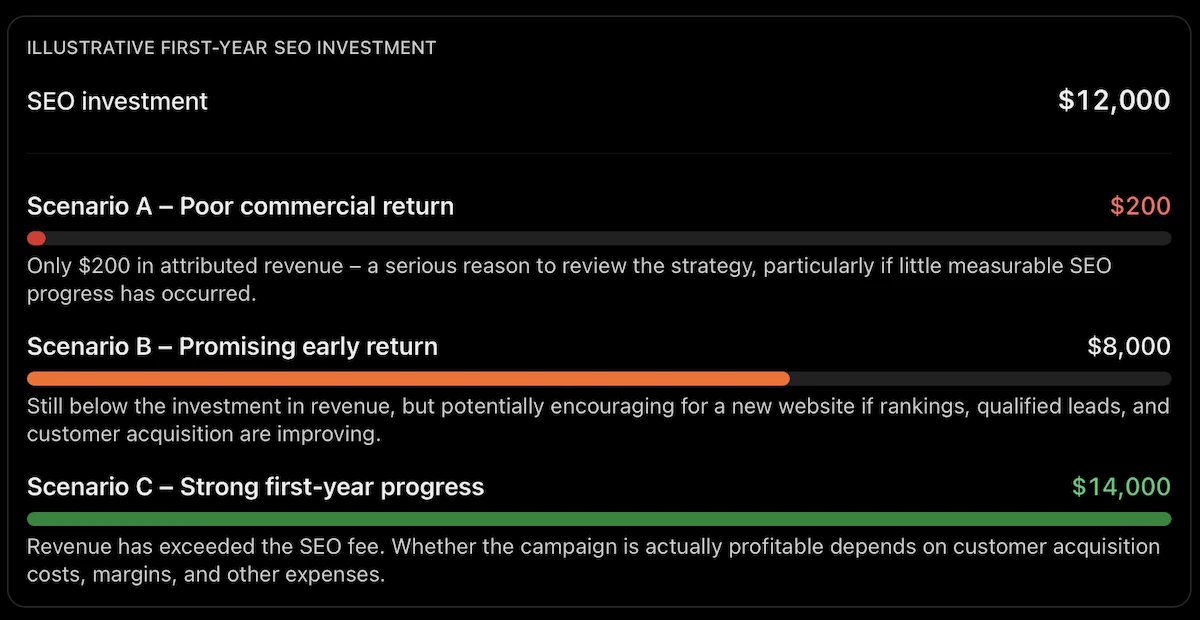
Notice something important: revenue isn’t the same as profit.
If your business generates $14,000 in sales but spends $10,000 delivering those services, you haven’t actually made $2,000 in profit after paying $12,000 for SEO.
For a more accurate financial evaluation, consider the gross profit generated by SEO-acquired customers, your SEO costs, and any additional acquisition expenses.
Customer lifetime value also matters. A customer who spends $500 today might return repeatedly over the next several years.
That’s why a first-year campaign showing a modest financial shortfall isn’t automatically a failure.
If your rankings are improving, qualified inquiries are increasing, and customers are beginning to arrive, you may be building a valuable long-term acquisition channel.
But if you’ve invested heavily for a year and have almost no ranking progress, no relevant traffic growth, and practically no genuine inquiries, it’s time for a serious conversation with your agency.
SEO requires patience, but patience shouldn’t become an excuse for unlimited spending without accountability.
How to Tell Whether Your SEO Company Is Doing a Good Job
You don’t need access to 15 different marketing platforms. You don’t need to understand Google’s algorithms. And you definitely don’t need to spend your weekends studying technical SEO.
What you need is a clear explanation of progress. A trustworthy SEO company should be able to show you where your important keywords ranked before the campaign, how those rankings have changed, whether relevant organic traffic has increased, how many genuine inquiries SEO has generated, and what those inquiries have contributed to your business.
More importantly, the company should explain what hasn’t worked and what it plans to improve.
If every monthly meeting consists of someone pointing at a green graph and saying, “Look, another 27% increase!”, ask what that increase actually means for your business.
Sometimes the explanation will be perfectly reasonable. SEO progress often precedes business results. But there should always be a clear connection between the work being performed, the improvements being measured, and the commercial goals you’re trying to achieve.
When choosing SEO Services, look for an agency that understands this distinction and doesn’t confuse impressive reporting with actual business growth.
A dependable Calgary internet marketing company should be comfortable discussing realistic timelines, competitive challenges, and financial outcomes – even when those conversations aren’t particularly glamorous.
At OrbiOn Digital, the focus is on helping businesses build a stronger digital presence through professional SEO, Local SEO, GEO, web design, and related digital marketing services. A free website audit or SEO consultation can also help business owners understand whether their existing strategy is producing meaningful progress or simply generating attractive reports.
The Bottom Line – Is Your SEO Working or Not?
The answer depends on what stage your campaign has reached.
After three months, especially with a new website, meaningful improvements in indexing and keyword visibility may be enough to indicate that things are moving in the right direction.
After six months, you should have a clearer understanding of ranking trends, relevant organic traffic, and early conversion performance.
After twelve months, you should be able to evaluate the entire picture – keyword progress, traffic quality, genuine inquiries, paying customers, and financial return.
Not every successful first-year campaign will be profitable. And not every campaign that hasn’t generated customers is necessarily being managed poorly.
But there must be measurable progress, a reasonable strategy, and a credible path toward business results.
SEO isn’t a lottery ticket, and it shouldn’t be sold as one. It’s a long-term investment in your business’s ability to attract customers through search.
And if your SEO company keeps showing you beautiful graphs while your business remains completely unchanged, don’t be afraid to ask the one question that really matters: “That’s great. But when does any of this start bringing me customers?”
A good SEO company won’t be offended by that question. It will have a meaningful answer.

Our team shares practical insights, helpful tips, and actionable strategies across SEO, paid advertising, social media marketing, website development, content, and more. We aim to make digital marketing easier to understand and help businesses grow online.
