
Search used to be a simple ritual: type a few words, scan a page of blue links, open five tabs, close four, and eventually discover that the “best answer” was written by someone who clearly had no idea what they were talking about.
Now the internet has hired a personal assistant with an encyclopedic memory and absolutely no sense of boundaries. People ask AI what to buy, where to travel, which product to trust, and sometimes questions that should probably remain between them and a bathroom mirror. Without AI, some of us would apparently struggle to choose lunch, plan a weekend, or locate the nearest toilet.
This shift is changing how businesses get discovered. Customers are no longer relying only on traditional search results and clicking through websites. They are asking ChatGPT, Gemini, Claude, and other AI platforms to research options, compare companies, summarize reviews, and recommend what to do next.
For businesses, that means visibility is no longer just about appearing as a link. Your company must also be clear, credible, and useful enough to become part of the answer.
Traditional SEO Is Still the Foundation
Traditional SEO is the process of improving a website so it appears in search engine results. It includes technical website improvements, keyword research, useful content, internal linking, backlinks, mobile usability, page speed, local visibility, and user experience.
In plain English, traditional SEO helps search engines understand three things:
- What your business does
- Whether your website is trustworthy
- Whether your content genuinely helps people
Google itself confirms that the fundamentals of SEO still matter for generative search. Its official guidance explains that AI features are built on Google’s existing search systems and rely on content found in its search index. In other words, traditional SEO has not disappeared. It has simply gained a new audience: machines that summarize and recommend information.
A website without a strong SEO foundation is like a restaurant with a beautiful sign but no kitchen. You can polish the menu all day, but there is still nothing good to serve.
Traditional SEO usually focuses on visibility in places such as:
- Google organic search results
- Bing search results
- Google Maps and local listings
- Image and video search
- Directory websites
- Industry publications
- Social platforms that influence discovery
It also creates the signals that AI systems may later use when deciding whether a company is credible enough to mention.
What Is AI SEO?
AI SEO, sometimes called Generative Engine Optimization or Answer Engine Optimization, focuses on making a business more visible in AI-powered search experiences.
These experiences include ChatGPT, Google AI Overviews, Gemini, Claude, Microsoft Copilot, Perplexity, and other tools that answer questions conversationally.
Instead of searching for “best website maintenance company near me” and opening ten tabs, a user might ask an AI assistant:
“Which digital marketing agencies offer SEO, paid ads, web design, and local marketing services for small businesses?”
The AI may produce a short list of recommendations. The user might never see the traditional search results at all.
That creates a new challenge. Your business is no longer competing only for a blue link. It is competing to become part of the answer.
This is where AI Optimization becomes valuable. The goal is to help AI systems understand your services, expertise, location, reputation, customers, and unique strengths clearly enough to mention your business accurately.
However, AI SEO is not a secret button hidden behind a suspiciously expensive subscription. There is no mystical “make me appear in ChatGPT” switch. If someone promises guaranteed placement across every AI platform, keep your wallet safely in your pocket.
Why AI Search Matters Now
The shift toward AI-powered discovery is already measurable.
Adobe Analytics reported that traffic from generative AI sources to U.S. retail websites increased by 1,200% in February 2025 compared with July 2024. During the 2024 holiday shopping season, that traffic increased by approximately 1,300% year over year. Adobe Analytics
That does not mean traditional search suddenly vanished. It means AI-assisted research is becoming an important part of the customer journey.
People are asking AI tools to:
- Compare products and services
- Find trustworthy local companies
- Summarize reviews
- Recommend software
- Explain complicated purchases
- Create shortlists
- Identify the best option for a specific budget or need
Google has also expanded AI-generated search experiences. Its AI Overviews provide summaries with links, while AI Mode allows users to ask follow-up questions and explore topics conversationally. Google Search
The important detail is that AI search still needs reliable information. It does not magically know which company provides excellent service. It gathers clues from websites, reviews, business profiles, publications, forums, and other online sources.
That is why reputation, clarity, accuracy, and consistency matter more than ever.
The Biggest Mistake: Skipping Traditional SEO
Many businesses hear that “people are searching through AI now” and immediately want to abandon traditional SEO.
That is like deciding to skip building the house because guests now use the front door instead of the driveway.
AI systems need a dependable foundation to work with. That foundation includes:
- A technically healthy website
- Clear service pages
- Helpful, original content
- Consistent business information
- Strong internal linking
- High-quality backlinks
- Positive reviews
- Clear author and company information
- Structured data where appropriate
- Fast, mobile-friendly pages
- Evidence of real expertise
Google’s guidance specifically states that there is no special AI markup or magic code required to appear in AI search features. The same core principles remain important: create useful, reliable, people-first content and make it accessible to search engines. Google Search Central
In practical terms, AI SEO is usually traditional SEO with an additional layer of clarity and strategic visibility.
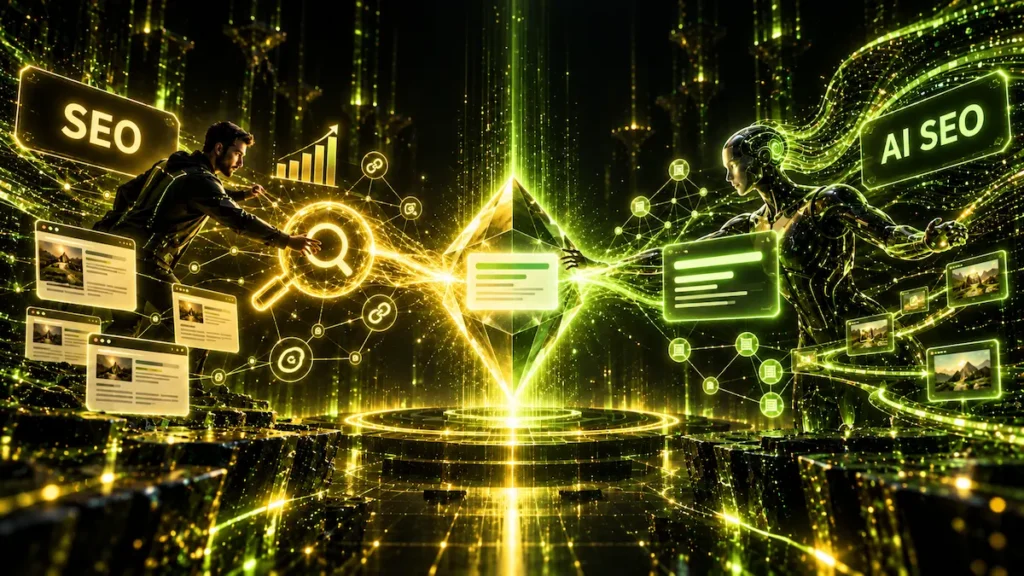
How Traditional SEO and AI SEO Work Together
Traditional SEO helps your website become discoverable.
AI SEO helps your information become understandable, quotable, and recommendable.
For example, a traditional SEO strategy may target a service page about paid advertising. It could improve the page title, headings, keyword usage, page speed, and links from other reputable websites.
An AI-focused strategy may then make the same page easier for language models to interpret by adding:
- Direct answers to common customer questions
- Clear descriptions of who the service is for
- Transparent pricing factors
- Real examples and results
- Service areas
- Frequently asked questions
- Authoritative references
- Consistent company details across the web
AI systems prefer information they can interpret with confidence. Vague claims such as “We deliver next-level digital growth solutions” sound impressive but explain almost nothing.
A clearer statement would be:
“We help small and medium-sized businesses improve organic visibility, generate qualified leads, manage paid advertising, and maintain fast, conversion-focused websites.”
Less glitter. More meaning. Machines appreciate that.
Why Content and Trust Matter More Than Tricks
AI platforms do not simply reward websites that repeat a keyword 47 times. In fact, awkward keyword stuffing can make a page look less trustworthy to both humans and algorithms.
The strongest websites demonstrate experience and usefulness. They answer real questions, explain complicated topics simply, and show evidence behind their claims.
A credible digital marketing company should be able to explain:
- What it does
- Who it helps
- How its process works
- What results can reasonably be expected
- Which services are included
- How success is measured
- Why its recommendations make sense
Trust is also built outside the website. Reviews, mentions in respected publications, industry links, social activity, business directories, and customer discussions all contribute to how a company is understood online.
This is especially important for SEO in Calgary, where local customers often compare several businesses before contacting anyone. A consistent presence across search results, maps, reviews, social media, and AI platforms helps reinforce the same message wherever people discover you.
Why Professional Help Makes Sense
SEO is often presented as something anyone can do over a weekend with a checklist and three cups of coffee.
Some basics are manageable. You can update a page title or write a helpful blog post. But effective SEO and AI visibility involve technical audits, analytics, content strategy, competitor research, link building, conversion optimization, reputation management, and continuous testing.
A small mistake can create bigger problems. Poor redirects can remove valuable pages from search results. Thin content can weaken a site’s credibility. Incorrect business information can confuse search engines and customers. An attractive website can still perform badly if it loads slowly or makes visitors work too hard.
That is where Orbion Digital can help businesses connect the pieces through digital marketing, SEO, AI optimization, local SEO, web design, website maintenance, paid ads, social media marketing, and website analysis.
The real advantage of working with professionals is not merely saving time. It is avoiding random marketing activity and building a coordinated system where the website, content, advertising, reviews, and customer journey support one another.
The Practical Strategy for the AI Search Era
A sensible approach looks like this:
First, repair and strengthen the website.
Next, build useful service pages and content that answer real customer questions.
Then, improve technical SEO, local visibility, reviews, internal links, and authority-building activities.
After that, make the information easier for AI systems to interpret by using clear language, structured page layouts, expert explanations, reliable references, and consistent business details.
Finally, measure performance across organic traffic, leads, calls, rankings, conversions, brand mentions, and AI referral traffic.
AI search is not replacing SEO. It is expanding the number of places where your SEO has to work.
The businesses that succeed will not chase every shiny new acronym. They will build something genuinely useful, trustworthy, technically sound, and easy for both people and machines to understand.
That is the real difference between a website that merely exists and a digital presence that gets recommended.
Let’s Make It Clear
No. AI SEO builds on traditional SEO. Technical quality, useful content, authority, reviews, and a strong user experience remain essential. AI SEO adds extra attention to clarity, structured information, brand reputation, and visibility across conversational search platforms.
There is no guaranteed instant method. AI platforms use different systems and data sources, and recommendations can change. A business improves its chances by building a trustworthy website, publishing useful content, maintaining accurate profiles, earning credible mentions, and demonstrating real expertise.
Yes. Google remains a major discovery channel, and AI search experiences often rely on information gathered from search indexes and trusted web sources. Traditional SEO continues to support visibility in both conventional and AI-assisted search.
Usually, no. Creating genuinely useful, well-structured content is more effective than producing artificial variations for every platform. The core information should be accurate and consistent, while the format can be adapted when a specific platform or audience requires it.
You can handle some basic tasks, but a complete strategy requires technical knowledge, consistent content production, measurement, and ongoing adjustments. Professional support can help identify hidden problems, prioritize opportunities, and connect SEO with web design, paid advertising, social media, and conversion goals.

Our team shares practical insights, helpful tips, and actionable strategies across SEO, paid advertising, social media marketing, website development, content, and more. We aim to make digital marketing easier to understand and help businesses grow online.