

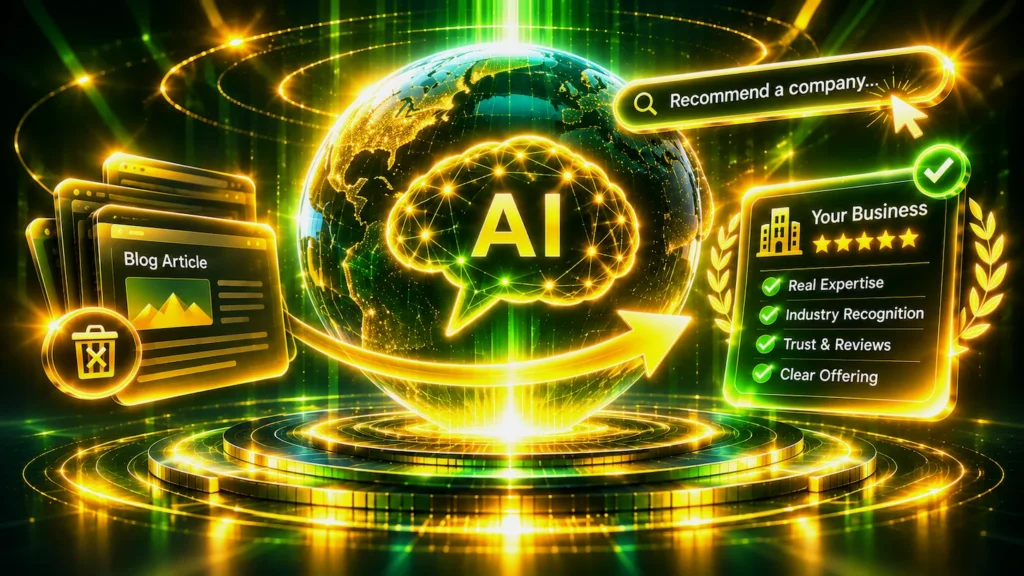
The rise of ChatGPT, Google AI Mode, Perplexity, and other AI-powered search platforms is changing SEO in several fundamental ways. Instead of simply optimizing websites to appear in search results, businesses must now consider how AI discovers information, combines multiple sources, interprets customer needs, and generates personalized business recommendations. The biggest transformation is happening in how information is discovered, selected, and presented to potential customers.
Now, ask ten SEO gurus how to optimize for AI search, and you’ll probably receive eleven different answers.
Some recommend publishing an extraordinary amount of expert content because AI makes production faster. Others insist that every page needs twenty frequently asked questions because apparently AI has developed an allergy to long paragraphs. Then there are enthusiasts of schema markup, llms.txt files, and, naturally, another generation of link-building specialists.
Listen carefully, though, and you’ll notice something amusing. Everyone seems to have discovered the revolutionary power of the word “more.”
More authoritative backlinks. More structured content. More technical optimization. More expertise. More trustworthy information.
Was the industry previously recommending unreliable backlinks, terrible content, and malfunctioning websites?
The uncomfortable truth is that nobody outside these platforms fully understands which factors consistently determine AI-generated recommendations. There is no universally proven formula for AI visibility.
However, several genuine changes are already transforming SEO:
From keywords to customer scenarios
From Unique Content to Unique Expertise
From Collecting Backlinks to Earning Recognition
From Optimizing Websites to Optimizing Business Entities
From Search Intent to Search Journey
1. From Keywords to Customer Scenarios
Traditional keyword research relies on specialized tools that help identify what potential customers search for, how frequently they search, and how competitive those queries are. This methodology remains relevant, but AI search introduces an entirely new layer of complexity.
When communicating with ChatGPT, users can describe their circumstances in remarkable detail – their location, budget, symptoms, previous experiences, personal preferences, and dozens of other variables. AI uses this context to generate responses tailored to their particular situations.
No conventional keyword research tool can comprehensively predict these combinations or reliably measure demand for them. Simply expanding your keyword list is not the solution.
Instead, your business needs to anticipate the different scenarios that could lead potential customers to its products or services.
Consider a veterinary clinic. A dog owner tells ChatGPT that their dog constantly licks its paws, recently switched food, and has developed redness between its toes. AI might explain several possible causes, including allergies, irritation, or infection. The owner may initially believe they have found the answer and don’t need professional assistance. However, as the conversation develops, additional symptoms could indicate the need for urgent veterinary care.
This is where modern SEO services for veterinarians take on an additional dimension. Your clinic’s website should address realistic combinations of symptoms, possible causes, warning signs, and circumstances requiring immediate veterinary attention. These scenarios can be incorporated into blog articles, service pages, and emergency care sections.
The idea is to make your business discoverable at different stages of an AI conversation, including the moment when someone realizes that information alone is no longer enough and professional assistance is necessary.
Traditional keyword research helps your business understand what customers are searching for. Customer scenario research helps you anticipate how an AI conversation could turn an initially informational question into a genuine need for your services.
2. From Unique Content to Unique Expertise
Before generative AI, businesses typically hired copywriters to produce original website content. Uniqueness was valuable partly because creating content required time, money, and research. Today, almost anyone can generate hundreds of seemingly original articles within hours. Uniqueness in wording has become a commodity, but uniqueness in knowledge hasn’t.
This has triggered endless debates about whether businesses should use AI-generated content. Entire companies have emerged selling AI content detection tools, while others sell tools designed to make AI-generated text appear human. Apparently, we now need artificial intelligence to disguise artificial intelligence from artificial intelligence.
The reality is that AI-generated content can rank well. The important question is not whether AI was involved in writing it, but what knowledge went into it.
In December 2022, Google expanded its E-A-T framework to E-E-A-T – Experience, Expertise, Authoritativeness, and Trustworthiness. The importance of genuine expertise, credible authorship, and professional reputation was therefore established before the current AI search boom. However, generative AI has made the distinction between professionally written content and genuine professional knowledge considerably more important.
When investing in SEO services for plumbers, for example, the greatest content asset isn’t necessarily an expensive copywriter or an advanced AI subscription. It’s the plumber’s twenty years of experience – the unusual problems encountered, the mistakes homeowners make, the solutions that actually work, and the practical nuances rarely documented online.
AI can turn that knowledge into a beautifully written article, but it cannot manufacture genuine firsthand experience. Publishing content under the name of a real contributing expert, supported by a credible professional profile and an established online reputation, helps demonstrate where that knowledge comes from.
So, what has actually changed? The cost and time required to transform expertise into publishable content have decreased significantly. However, acquiring, documenting, and communicating that expertise still requires substantial effort.
The competitive advantage is shifting from the ability to produce unique text to the ability to provide unique knowledge. AI should be your editor and writing assistant, while your business remains the source of expertise. Professional SEO company in Calgary can help turn that combination into content that addresses genuine customer needs rather than simply adding another thousand articles to an already overcrowded internet.
3. From Collecting Backlinks to Earning Recognition
Backlinks have been a cornerstone of SEO since its early days, and they are unlikely to disappear anytime soon. With the arrival of AI search, the industry has once again reached for its favourite word – more. More authoritative, more relevant, and more trustworthy backlinks. But this time, there is a genuinely interesting shift behind the familiar advice.
Let’s take a business specializing in hair extensions as an example. A traditional link-building strategy might include dozens of placements on general news websites, several beauty blogs, industry directories, and a hundred forum links. Individually, these links might offer relatively little value, but collectively, a diversified backlink profile could support organic rankings.
Now consider a genuine editorial recommendation from Cosmopolitan or a substantial feature in Forbes. From an AI search perspective, these publications are not merely domains with impressive authority scores. They are recognizable sources with established reputations, editorial histories, and identifiable expertise.
The context of a recommendation may become particularly valuable. A beauty journalist explaining why a particular hair extension brand stands out provides information that AI can potentially incorporate into its own recommendations. Three hundred anonymous backlinks may offer far less useful information about why someone should choose that business.
Even the traditional obsession with dofollow and nofollow links deserves reconsideration. A nofollow link from a respected industry publication may offer limited conventional ranking benefits, yet the surrounding editorial recommendation could still provide valuable information for AI-generated answers.
Does this mean spending $10,000 on a single premium media placement? Absolutely not. An expensive sponsored article is not necessarily an authoritative endorsement, and nobody has established that one prestigious backlink automatically outweighs hundreds of ordinary ones in AI search.
What is changing, however, is the strategic allocation of link-building budgets. Rather than purchasing large quantities of inexpensive placements, businesses should increasingly prioritize recognition from respected, highly relevant publications, industry experts, and established professional communities.
In other words, link building is becoming less about accumulating digital votes and more about earning endorsements that actually mean something.
The distinction is subtle but commercially significant. Traditional link building asks who links to your website. AI-era link building must also ask whose recommendation would genuinely make your business worth choosing.
4. From Optimizing Websites to Optimizing Business Entities
Traditional SEO places considerable emphasis on website optimization – title tags, headings, keywords, internal links, loading speed, and technical performance. None of these elements has suddenly become irrelevant. However, AI search expands the object of optimization from a website to the business itself.
This brings us to the concept of a business entity – a recognizable company with identifiable characteristics, professional expertise, reputation, relationships, and a verifiable history across the digital landscape.
A website can claim to offer the best solutions, employ exceptional professionals, and have 500 satisfied customers. But where is the evidence? A beautifully designed banner announcing customer satisfaction is not the same as independently verified customer satisfaction.
Business entity optimization involves several interconnected elements:
Customer reputation – authentic reviews on Google, Trustpilot, Clutch, HomeStars, and other relevant platforms.
Professional identity – identifiable business owners, qualified employees, certifications, and documented industry experience.
Commercial information – clearly defined services, pricing, service areas, availability, delivery conditions, and customer requirements.
Business history – years in operation, completed projects, documented case studies, and professional achievements.
Industry recognition – professional memberships, awards, partnerships, and presence on respected industry platforms.
Digital identity – consistent business information, relevant social profiles, and independently verifiable brand mentions.
The important part is how these elements connect. AI can retrieve information from multiple sources and assemble a broader picture of your business. Ten genuine, independently accessible reviews may provide more credible evidence than a website banner claiming hundreds of happy customers.
When investing in HVAC SEO services, for example, establishing a credible presence on HomeStars, documenting professional qualifications, publishing actual installation projects, and maintaining an accurate Google Business Profile may deserve considerably more attention than posting daily promotional messages on Instagram.
For a beauty business, however, Instagram could be an important part of its digital identity, demonstrating actual results, professional skills, customer experiences, and industry recognition.
This introduces another significant change. Businesses should reconsider which digital platforms deserve their marketing budgets based on their industry’s characteristics and the information sources relevant to customer recommendations. Not every business needs an active presence on every social network. Posting another air conditioner installation discount simply because Tuesday is apparently content day serves little strategic purpose.
AI search doesn’t eliminate the need for on-page or technical SEO. Instead, it makes website optimization one component of a much broader objective – establishing a coherent, credible, and independently verifiable business identity.
Ultimately, your website is what you say about your business. Your business entity is what the digital world can establish about it. In the AI search era, the relationship between those two becomes increasingly important.
5. From Search Intent to Search Journey
For years, SEO strategies were built around four types of search intent – informational, navigational, commercial, and transactional. Businesses invested heavily in blog content to attract people at the beginning of their purchasing journey, hoping to eventually convert readers into paying customers through internal links, service recommendations, and strategically placed calls to action.
AI search is disrupting this entire business model.
One of the biggest misconceptions in modern SEO is that getting your blog cited by AI automatically creates a commercial opportunity. An AI assistant might use your article to answer a question, but the user may never visit your website, notice your brand name, or discover the services you offer. Your beautifully designed “Get a Free Quote” button remains untouched. You’ve essentially helped AI serve its customer without necessarily gaining one yourself.
Let’s take a company selling custom kitchen cabinets as an example. Before AI search, a homeowner might read separate articles about cabinet materials, design trends, storage solutions, installation costs, and the advantages of custom cabinetry. Each article represented an opportunity for a business to attract and convert a potential customer.
Today, that entire research process can take place within a single AI conversation. The homeowner can spend forty minutes discussing kitchen layouts, comparing materials, calculating expenses, and refining design preferences without visiting a single cabinet manufacturer’s website.
Then comes the commercially valuable question: “Based on everything we’ve discussed, recommend three companies that can manufacture and install these cabinets within my $25,000 budget.”
That is the moment your business needs to be discovered.
Everything discussed in the previous four sections comes together here – anticipating customer scenarios, demonstrating genuine expertise, earning authoritative recommendations, and establishing a credible business identity.
Consequently, businesses should reconsider how much of their SEO budget goes towards generic informational content and how much goes towards becoming a compelling choice when customers are ready to purchase.
This doesn’t mean abandoning blogging altogether. It means giving every piece of content a commercially meaningful purpose rather than publishing articles simply because a keyword research tool promises thousands of monthly searches.
The informational stage of the purchasing journey hasn’t disappeared – much of it has simply moved inside AI platforms. Your SEO strategy must account for that change.
Traditional SEO was largely about bringing customers to your website and guiding them towards a purchasing decision. AI-era SEO is increasingly about ensuring your business becomes part of that decision before customers ever reach your website.
Has AI Fundamentally Changed SEO? Absolutely.
At first glance, the difference between traditional SEO and AI-era SEO might seem surprisingly small. We still need valuable content, authoritative backlinks, technical optimization, and credible businesses. Even experienced SEO gurus struggle to explain what has fundamentally changed without adding the word “more” to every familiar recommendation.
More authoritative content? More relevant backlinks? More structured information? Were these things optional before?
But the devil is in the details.
As the five changes discussed above demonstrate, AI hasn’t necessarily reinvented the individual components of SEO – it has fundamentally changed how they must work together. Generating content is easier, but demonstrating genuine expertise is harder. Acquiring backlinks remains important, but earning meaningful recognition becomes increasingly valuable. Optimizing a website is still essential, but establishing a credible business identity extends far beyond its boundaries.
Most importantly, being cited by AI and being recommended by AI are two very different achievements.
Your business could invest thousands of dollars in producing hundreds of articles, become a frequently cited source in ChatGPT, and still watch AI recommend your competitors when someone actually asks where to purchase a product or order a service.
Congratulations – you’ve become AI’s unpaid research assistant.
As AI becomes increasingly sophisticated in interpreting information and customer requirements, your SEO strategy must become equally sophisticated. The challenge is not simply doing more, but understanding precisely what deserves more investment and what no longer justifies the expense.
At OrbiOn Digital, our approach to SEO, GEO, and digital marketing in Calgary focuses on adapting businesses to this changing search landscape without wasting their budgets chasing fashionable optimization theories. Our free website audit and digital marketing consultation can help identify where your business should concentrate its efforts.
Ultimately, the purpose of SEO has never been to impress search engines, and it certainly shouldn’t be to impress ChatGPT.
The goal isn’t to become AI’s favourite source of information. It’s to become the business AI has a compelling reason to recommend when a customer is ready to buy.
Let’s Make It Clear
Yes, but achieving high organic rankings and becoming an AI-recommended business are different objectives. Traditional SEO helps customers discover your website, while AI-era SEO must also establish why your business is a suitable choice for specific customer circumstances. The foundations remain, but the strategy has fundamentally changed.
Quantity alone is meaningless. You could publish a thousand genuinely expert articles, increase your AI search visibility, and even become a frequently cited source in ChatGPT. But there are two fundamental questions. First, how can you realistically produce a thousand articles containing genuine expertise in a short period? AI can accelerate writing, but it cannot accelerate the acquisition of professional experience. Second, even if AI regularly cites your content, will it recommend your business when someone is ready to buy? Greater visibility without commercial results is an expensive achievement with questionable value.
Absolutely, but businesses should reconsider where their link-building budgets go. A meaningful editorial recommendation from a respected industry publication may offer greater strategic value than hundreds of generic backlinks. Even unlinked brand mentions and nofollow links can contribute useful information that AI may retrieve when evaluating businesses.
Because answering a question and recommending a business are two different tasks. Your website might contain excellent educational content, while your competitor has stronger independent reviews, documented expertise, industry recognition, and a clearer commercial offering. Being a useful information source does not automatically make your business the preferred purchasing choice.
Businesses should prioritize anticipating customer scenarios, documenting genuine expertise, earning credible industry recognition, strengthening their digital business identity, and optimizing for purchasing decisions. Before investing in another hundred blog posts or backlinks, ask a simple question: will this give AI a compelling reason to recommend my business when someone is ready to buy?

Our team shares practical insights, helpful tips, and actionable strategies across SEO, paid advertising, social media marketing, website development, content, and more. We aim to make digital marketing easier to understand and help businesses grow online. More About Us
